Cas-Analyzer
NGS-based genome editing analysis, run entirely in your browser
A nuclease cuts, the cell repairs, and what the repair left behind is readable in the sequence of an amplicon across the cut site. Cas-Analyzer reads it: it takes the sequencing reads of an edited amplicon, groups them by the sequence they carry around the cleavage point, aligns each distinct one against the reference, and reports how many were left wild type, how many carry an insertion, and how many carry a deletion.
Sequencing data is read locally and never uploaded. Large FASTQ files are streamed from disk in a background worker.
Target
Enter the target without the NGG PAM — the protospacer only, typically 20 nt.
Sequencing reads
Pairs are merged with a fastq-join port (minimum overlap 6 bp, up to 8% mismatch).
Parameters
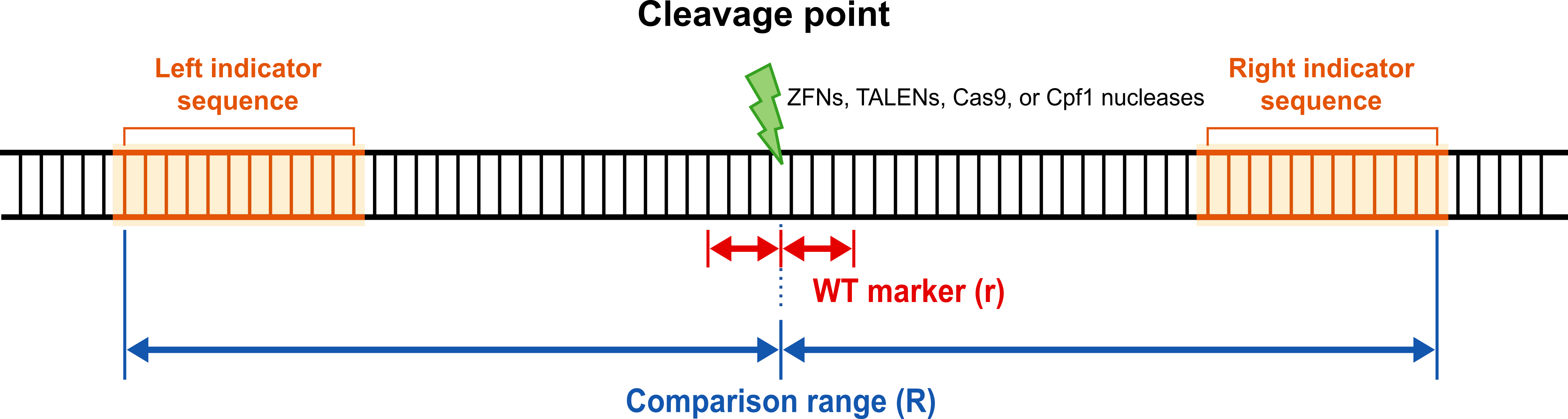
Reads are compared over R bp either side of the cleavage point. The outermost 15 bp of that window are used as anchors, matched allowing one mismatch.
Sequences observed n times or fewer are discarded.
Reads containing the r bp either side of the cleavage point are always counted as WT or substitution, whatever their length.